


The Cannibal’s Dilemma
Let us approach mining using First Principles.
Mining is an extractive industry that consumes itself year-by-year. To wit: every tonne of ore mined is one less tonne in the ground. Every ounce poured shrinks the reserve base. Whether the commodity is gold, silver, copper, nickel, iron ore or oil, the principle is the same. Production is depletion and depletion is destiny, unless the company doing the extracting can continuously replace what it extracts.
In practice, however, most miners are chronically bad in the replacing game. Not just in absolute terms, but in the only terms that matter to shareholders: per share.
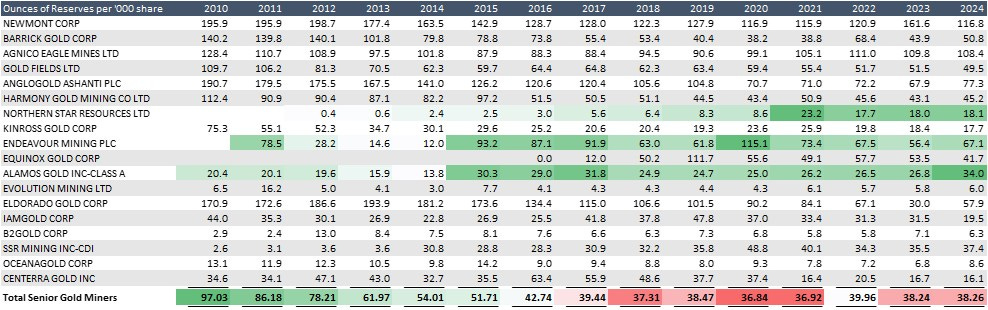
That is why I keep coming back to Reserves per Share (as first presented here), in the table below measured as ounces of reserves per 1,000 shares. It collapses all the usual excuses into a single number: geology, M&A discipline, capital allocation, and dilution.
Solving for Reserves per Share yields a brutal insight: as a group, senior gold miners went from 97.03oz per 1,000 shares in 2010 to 38.26oz per 1,000 shares in 2024. That’s a long-term, structural transfer of value away from existing owners.
Put differently, mining is an awkward place to hunt for moats.
Most industries are structured in such a way that an exceptional entrepreneur can build a business where time becomes an ally. They leverage their unique strengths to establish a strategic advantage, which can manifest in novel ways.
Consumer brands, like Coca-Cola or WD-40, embed habit and distribution. Buffett calls this “share of mind”. Luxury houses, like Hermès, embed scarcity and pricing power. Media and software platforms, like Alphabet, grow revenues while marginal costs remain stable, which is the Network Effect in action.
Great financial franchises, like Berkshire Hathaway or Svenska Handelsbanken, compound because they reinvest into systems, relationships, and underwriting cultures that scale. In Berkshire’s case, the growing insurance float became the cheap capital Buffett could redeploy at attractive returns.
Even in industrials, the best operators build moats through installed infrastructures, service revenues, technical know-how, and procurement scale. Think Siemens Energy and its gas turbine business.
Buffett has a clean way of putting it: the best businesses make time their friend. Bruce Greenwald explains the machinery behind this beautifully in Competition Demystified. The essential point is: When a moat exists, compounding becomes natural because the business gets stronger as it grows.
In mining, that kind of compounding is rare.
True, miners can enjoy a supply-side advantage; they own a specific resource. Yet, that advantage comes with a string of sunset clauses, e.g. reserves are finite, licences have durations. The tough truth is that even the best ore body is a wasting asset in a legal wrapper. This is why land optionality matters so much; it is the closest thing the mining sector has to extending the time horizon of a good asset. And it’s why many “high quality” miners still struggle to become true long-duration compounders.
Worse, resource companies are price takers, i.e. they do not set the price of gold, copper, or oil. (Pro tip: When someone in a Patagonia vest utters the comfortable (but false) macro line that ‘commodities protect you from inflation’, it’s best to ask which part of the chain has pricing power. The cleanest inflation hedge is a company with durable pricing power, not “real assets” in the abstract. Commodity producers often have the opposite. Input costs can rise while realised prices fall. Commodity cycles do not care about macro theses. Remember that please when you read the next stupid line like it.
Worse still is above-ground risk, that inchoate discomfort that masquerades as political interference, windfall taxes, permitting delays, social licence, or good old corruption. That’s when you build the perfect mine with one set of rules and then watch it all slip away as the rules change because of reasons. Investors learned that that hard way, in Panama, with First Quantum’s Cobre Mine in September 2023. They were reminded again across West Africa, including Burkina Faso’s more assertive stance in 2025.
And Western jurisdictions are not immune. The UK’s 2022 windfall tax episode in oil and gas was a blunt reminder that “rule of law” does not mean “rule stability”. In the United States, the slow-motion theatre of permitting and NIMBY politics (Not In My Back Yard) has become its own form of de facto expropriation. No wonder generalist investors keep their distance.
So, if lasting moats are scarce in mining, then where are they and when do they manifest?
Spoiler Alter: Usually not from geology alone, even when the geology is spectacular. Lundin Gold’s Fruta del Norte is as close to what consider a geological unicorn. K92 has extremely rare growth qualities. Island Gold is a very special asset with grades steadily increasing as the mine goes deeper. Yet, the depletion clock still ticks percussive effect on all of them, and above-ground risk still applies in each case, particularly in Ecuador and Papua New Guinea.
However, when a mining company builds something approaching a moat, it comes from the firm’s winning culture, operational excellence, disciplined capital allocation — all of which repeated over decades. You see it in all of the best operators, without exception. That’s why I have previously emphasised what culture does for names like Alamos Gold, Agnico Eagle, and historically for Endeavour Mining.
Which brings us to G Mining Ventures (GMV).