


Executive Summary
The Iran war has caused the largest supply shock in petroleum history. Yet even when the fighting was most intense, oil prices only briefly touched the $150/bbl that many analysts and investors, myself included, had predicted at the outbreak of the conflict.
For that, thank a handful of governments. Soon after Iranian munitions made the Strait of Hormuz impassable, trapping 14mbpd of crude inside the Gulf, the petro-monarchs in Riyadh and Abu Dhabi pushed over 3mbpd extra through pipelines bypassing the strait. At the peak, 7.2mbpd flowed around Hormuz, up from under 4mbpd before the war. Washington and Tokyo released a record 2mbpd from emergency stocks. State-led rationing in poorer countries shaved off another chunk of demand.
But disaster would still have struck without decisions quietly taken in another capital: Beijing. Between February and June, China slashed its seaborne crude imports by half, withdrawing 5.5mbpd of buying from the global market, enough to take $30/bbl or more off Dated Brent.1
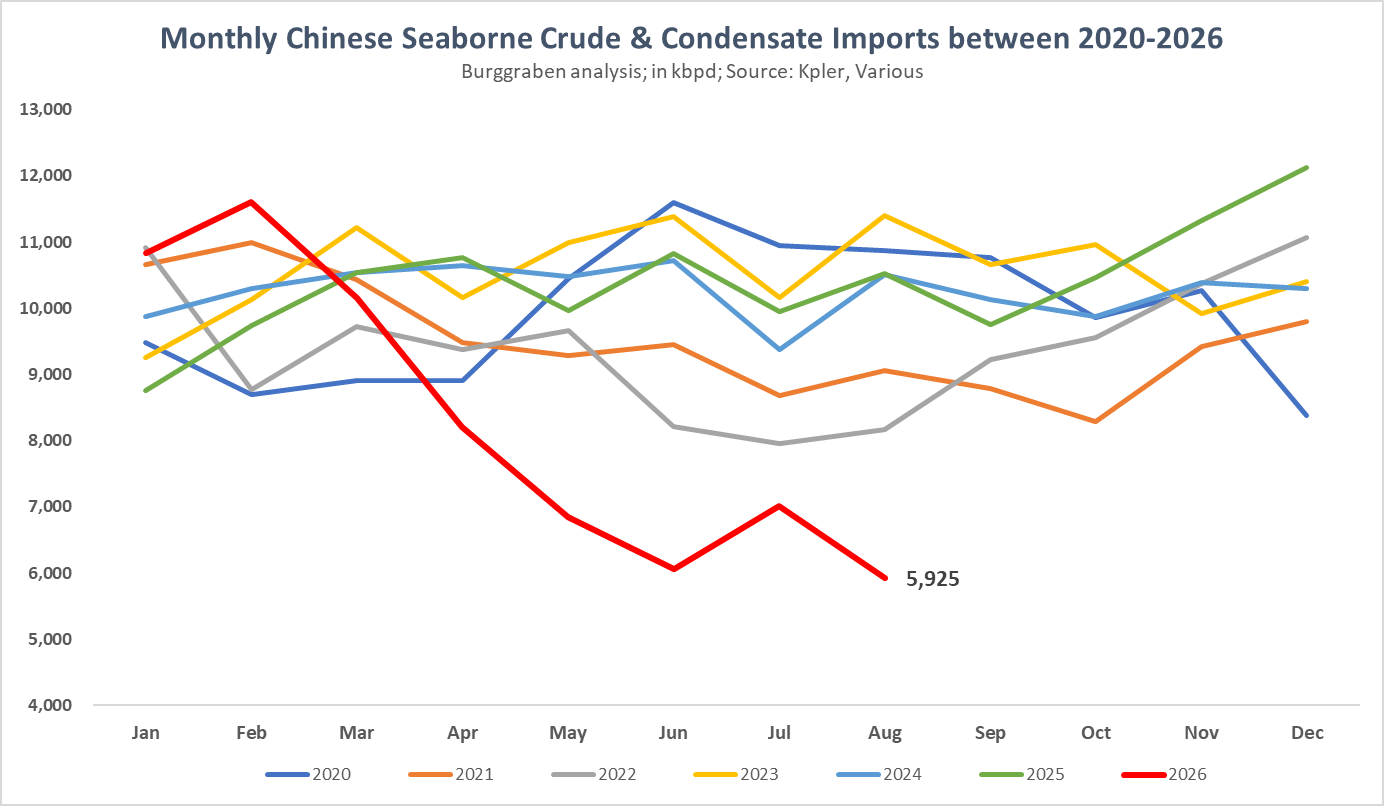
Let that sink in: more than half the worldwide demand destruction during the Covid-19 lockdowns, when global consumption fell by 9mbpd. With one crucial difference. During Covid, demand disappeared because the world economy shut down. China’s economy today is struggling enormously, but not because it lost access to 5.5mbpd of foreign crude. China chose to stop buying those barrels and, economically, barely felt the difference.
Such resilience is no accident. In November 2003, Hu Jintao warned that “some major powers” were seeking to control the Strait of Malacca, through which four-fifths of China’s imported crude then travelled. Chinese media soon gave the vulnerability a name: the “Malacca Dilemma”. As China Youth Daily put it in 2004, whoever controls Malacca “controls China’s energy route”.
Beijing spent the next two decades building against precisely that vulnerability, raising domestic energy production, electrifying transport, diversifying supply routes and accumulating strategic stockpiles. Under Xi, energy independence went from strategy to obsession.
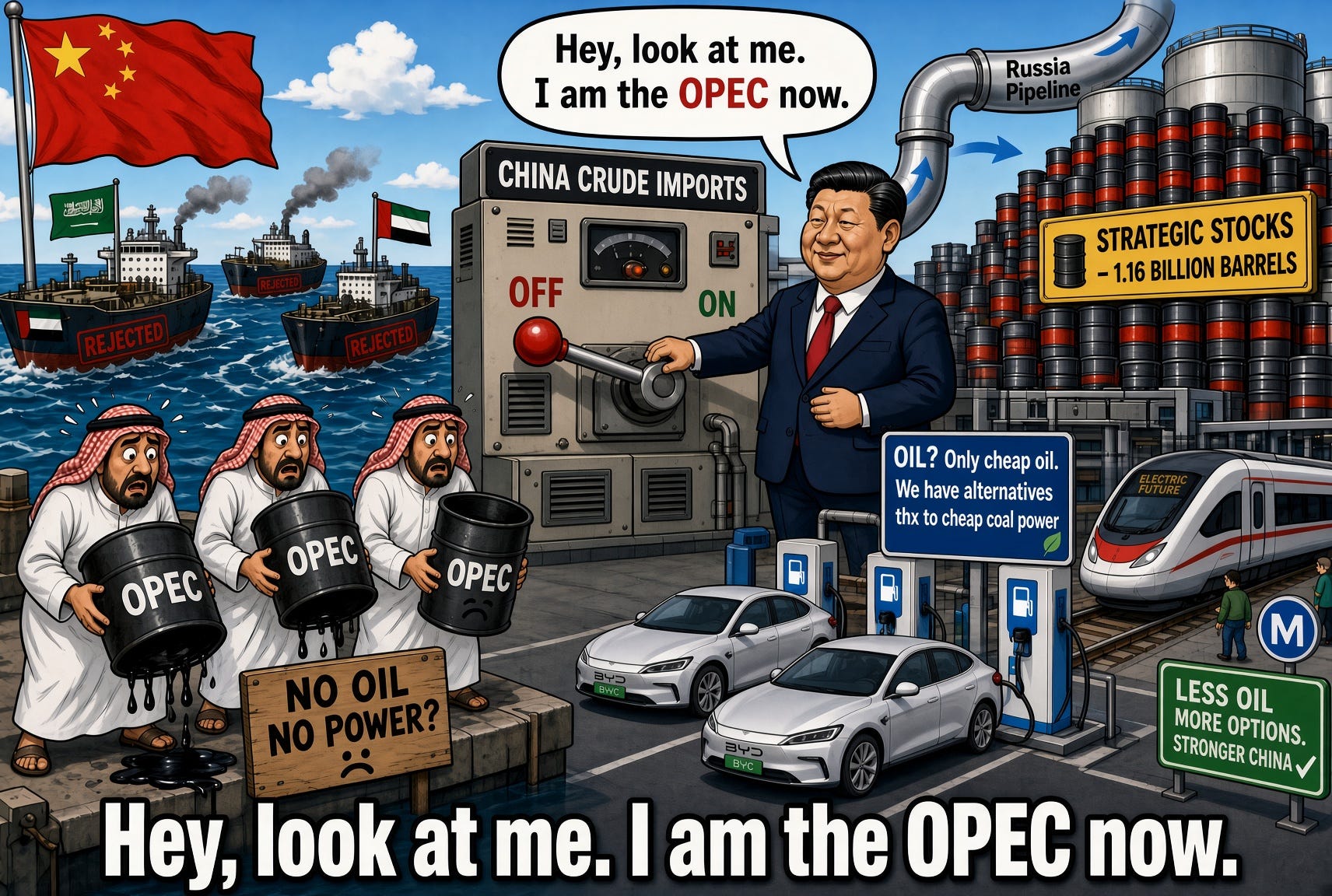
A system designed with a future conflict over Taiwan in mind has now proved itself in the Strait of Hormuz. That ability to switch enormous volumes of crude imports on and off, at surprisingly little economic cost, hands the world’s biggest oil importer the pricing power OPEC once exercised from the supply side: real power from 1965 to 1989, mostly pretended power after 1990, as we showed in Episode 4.
And with the cartel further weakened by the departure of the United Arab Emirates, one of only three members besides Saudi Arabia and Kuwait holding genuine spare capacity, China’s market power has overtaken OPEC’s - by a country-mile.
As one oil-trading boss put it: “China is the new OPEC.”