


Executive Summary
Today we have a closer look at the Bab el-Mandeb chokepoint and why it matters for global oil and product flows.
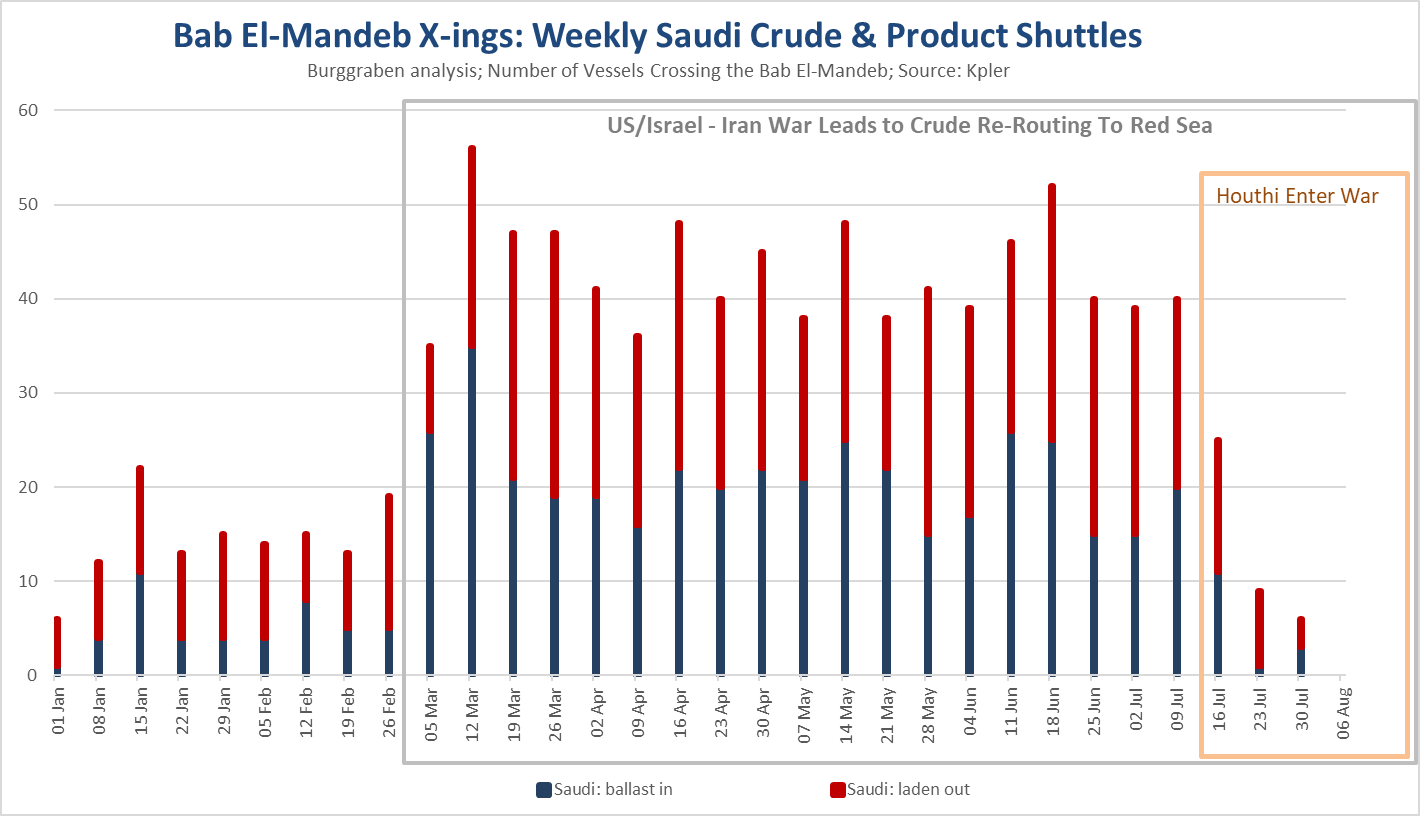
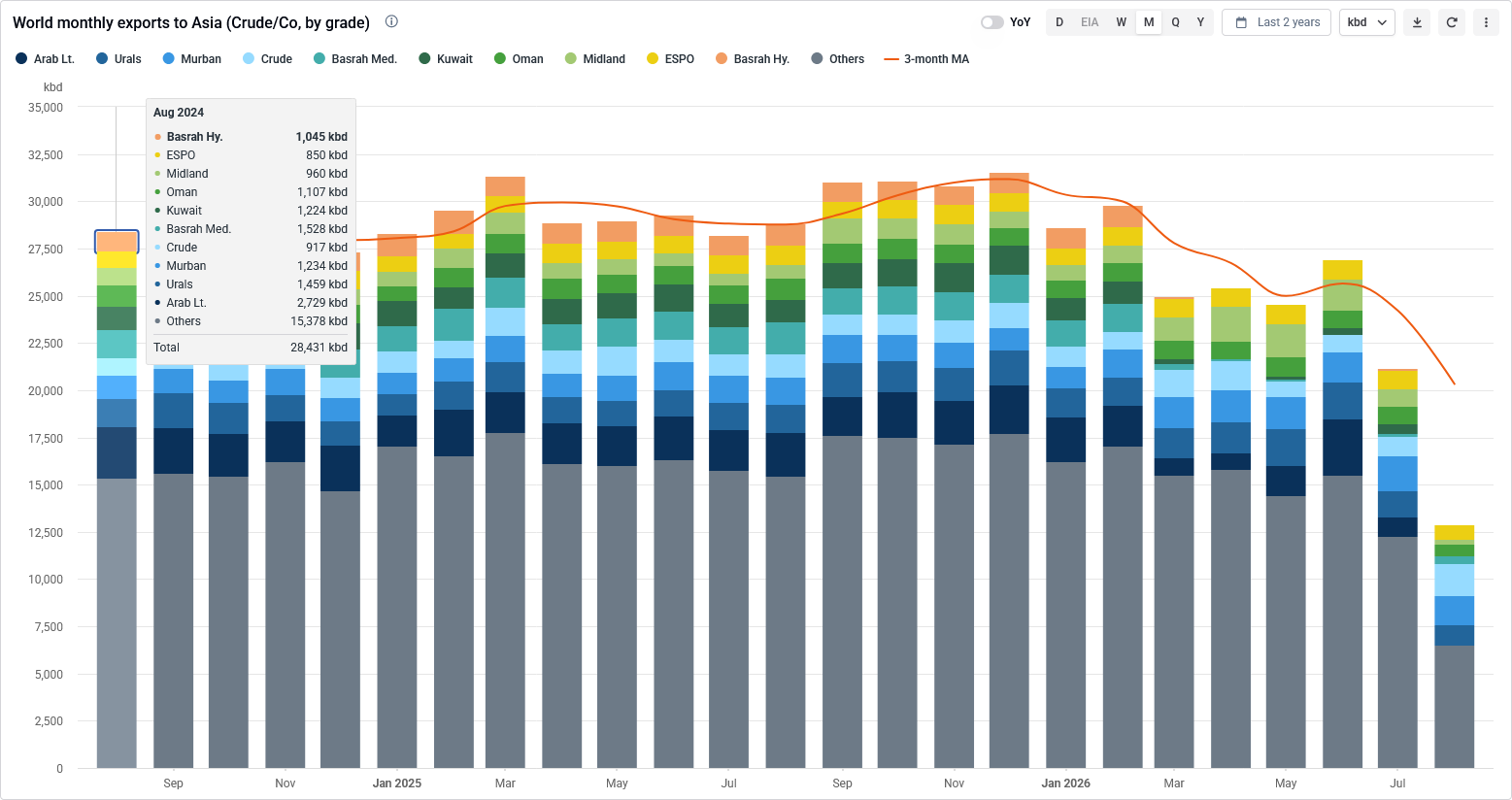
The headline is difficult to overstate: Saudi crude exports have crashed. Our August data show crude exports running roughly 74% below the pre-war baseline. That is not simply a shipping-route change. The volume itself is missing. At the same time, some of the barrels that still leave Saudi Arabia are being forced north through Egypt rather than south through the Bab el-Mandeb.
So there are really two stories unfolding at once. First, a Saudi export crash. Second, a Saudi export detour. The second matters because a Saudi barrel that previously reached Asia in 21 days can now require 49 days. The extra freight alone costs upward of $3/bbl, before working capital, insurance and all the additional hassle. Saudi Arabia’s geographic advantage into Asia has suddenly shrunk dramatically.
And that creates the real puzzle. Saudi Arabia is exporting materially fewer barrels, while the barrels that still make it out have become materially more expensive to deliver into Asia. On a shipping map, the obvious conclusion is that Atlantic Basin crude should be flying off the shelf.
It isn’t. That is where this episode gets interesting. A missing Saudi barrel is not automatically replaced by the next available barrel on the water. Crude quality, refinery metallurgy and the willingness of the marginal buyer matter just as much as freight. And right now, that marginal buyer is China.
Deal Or No Deal?
This week, Iran’s Foreign Minister Abbas Araghchi said negotiators are closing in on a temporary maritime transit route for ships entering and exiting the Persian Gulf. Oman said separately, in a post on X (link), that negotiations are progressing in “a positive and constructive atmosphere” and called for a halt on actions in the strait to avoid impacting diplomatic efforts to reach an agreement on navigation.
Are they? From where I sit, nothing has changed — if anything, the recent news flow has confirmed my theory that these two sides are too far apart to ever find a compromise. What do I mean?
First, if we got three lanes — an Omani, an Iranian and an IMO lane, as traffic patterns have established over the past five months and assuming no hot war and shipping attacks — flows could partly or near fully recover. But Iran would effectively lose control over the Strait.
Obviously, that would be an acceptable solution for the U.S. to lift sanctions and, perhaps, even allow the release of frozen funds. It would likely also be an acceptable compromise for the Gulf states, namely the UAE, Saudi Arabia, Qatar, Kuwait and Iraq.
The UAE and the Saudis in particular would likely find an amicable solution with Oman to avoid any fees, while Qatar and Iraq would perhaps be happy to pay Iran some service fee to close this chapter once and for all. Who knows.
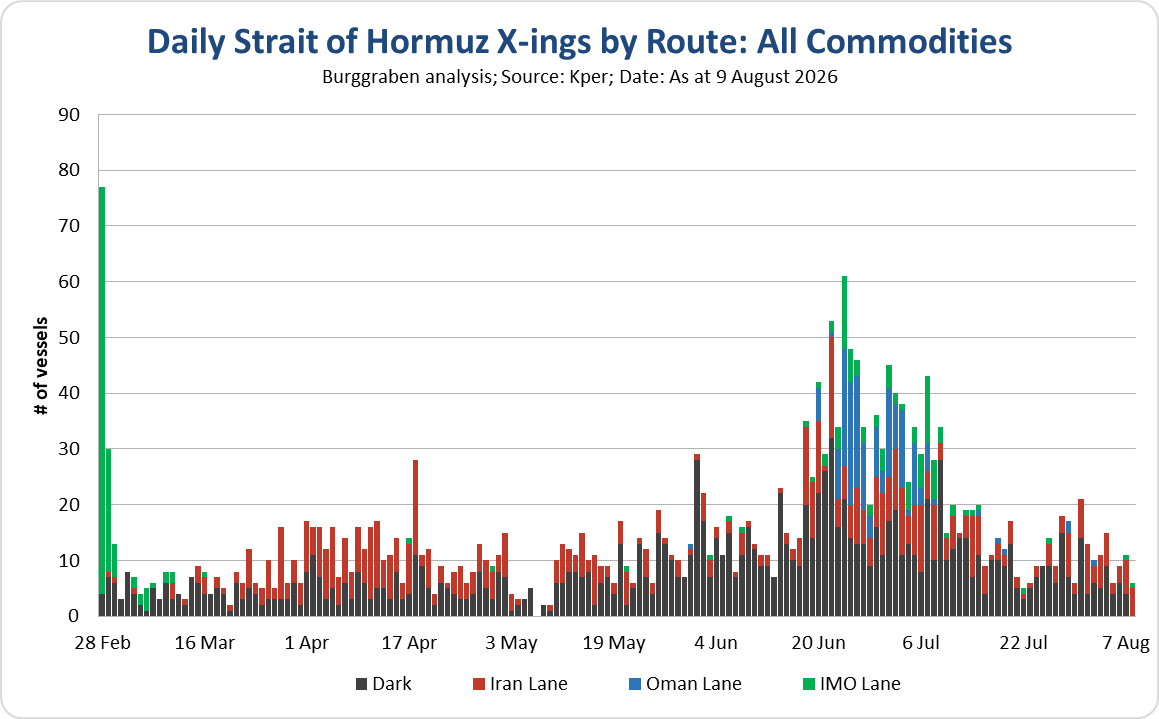
However, the Strait has become the life insurance of the regime in Tehran, so it won’t happen. Instead, and according to the WSJ (here and here), Iran insists on asserting control over the Strait. The WSJ wrote:
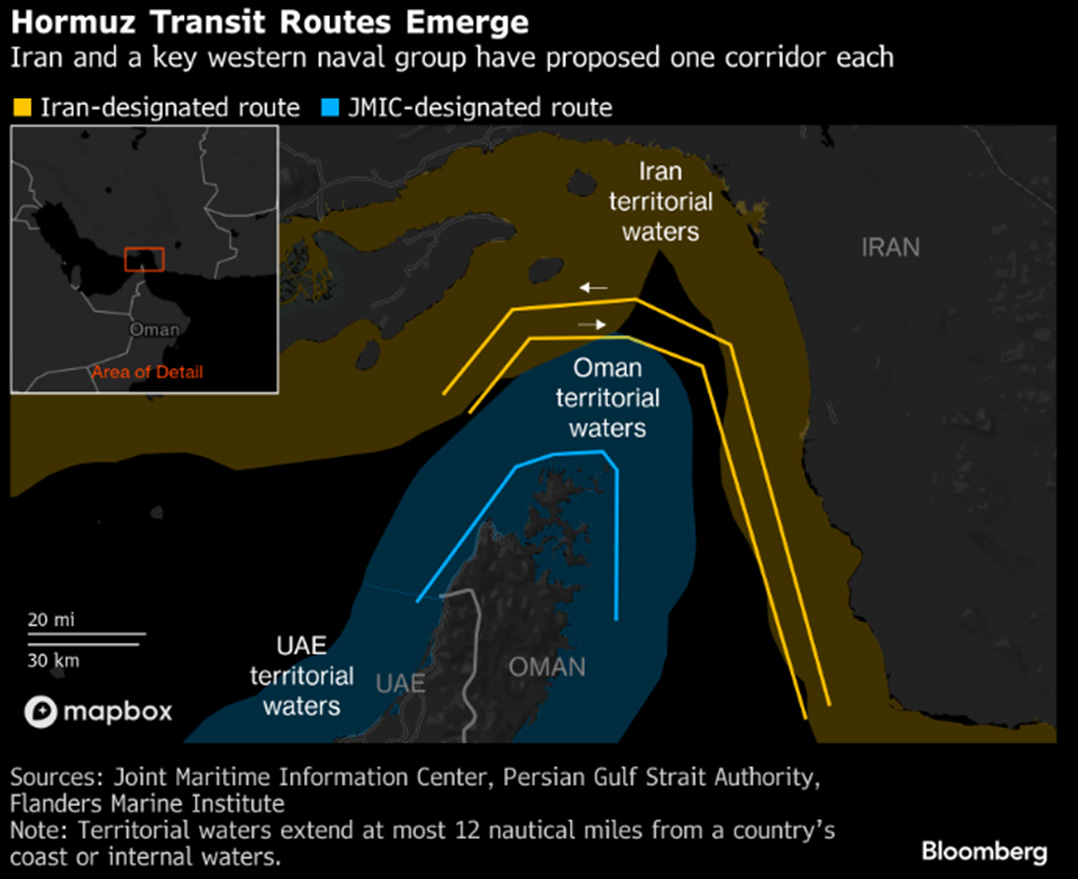
The parties have agreed on the main points of the draft—which would set up an inbound lane near Iran and an outbound lane near Oman—and have shared it with the U.S., countries in the region and Iran’s top leaders, who still needed to sign off, they said.
According to the draft proposal, which would last for 60 days, ships entering the strait would use the route closest to Iran in coordination with Tehran, and ships exiting the strait would use a route in the Omani waters in coordination with Muscat, the people said.
While the deal would exclude charging ships tolls or fees, Iran might not be prevented from collecting voluntary payments to cover costs like security and search and rescue, the people said.
The above terms leaked on 5 August. The same day, the Hormuz Letter (link) reported that Iran is insisting on a 7% fee on all commercial ships passing the Strait. That demand is not going away — and meanwhile, the IRGC’s Brigadier General Ahmad Vahidi remains in charge of the Strait. Here is what the Hormuz Letter explained:
Iran is demanding a fee of 7% on all commercial ships passing through the Strait of Hormuz, with Chinese and Russian vessels exempt from the fee, while Oman is discussing smaller fees of around 3% and the US wants no fees at all, per Reuters and an Iranian source.
A 7% fee on 20mbpd of oil and products at, say, $75 Brent would mean the regime collects some $40 billion per annum — before counting LNG, LPG and other cargoes — thereby also elegantly circumventing sanctions, as the fee could otherwise not be collected.
Trump won’t approve any of this, but I keep an open mind into the midterms for another “Memorandum of Misunderstandings” — perhaps this time one to which the United States is not even a party, which seems to be what Iran is angling for. But then how would Iran get sanctions relief, among other things?
According to the New York Times (link), Iran’s top security official followed up on the Oman deal rumour by stating that the Strait of Hormuz will not reopen until the U.S. meets a sweeping list of demands:
1. Lifting its naval blockade;
2. Lifting sanctions on Iranian oil, petrochemical and gas exports;
3. Releasing all of Iran’s blocked funds and paying war reparations;
4. Ending the war in Lebanon;
5. Accepting Iran’s right to collect maritime fees on every ship;
6. Withdrawing the U.S. military from around Iran.
Once the U.S. implements these commitments, Iran says, the Strait of Hormuz will reopen — under full Iranian sovereign control.
So forgive me if I don’t hold my breath for a deal to emerge next week. My view is unchanged since March 2026: Iran’s maximalist demands make negotiating a waste of Trump’s time. In reality, there are only two paths to restoring normal oil flows in the Middle East:
a) Regime change;
b) Bypassing Hormuz.
Version (b) remains vulnerable to attacks but is superior to vessel transits through Hormuz. Judging by an interview yesterday, Treasury Secretary Bessent seems to agree with me.
The U.S. administration is playing for time — lower oil prices into the midterms — and has lost faith in a meaningful “deal” with this regime. After that, it will either walk from the conflict and let the oil suppliers bypass Hormuz with pipelines, or it will escalate the war until the regime falls, or a combination of both. As Walter Russell Mead wrote in the WSJ, this war is “irrepressible”.
None of that means Brent won’t trade down on any new headline of an imminent deal, however absurd and detached from reality it may be. But that is precisely the game the U.S. administration is playing here — and for now, it is playing it rather successfully, if WTI is your measure. If gasoline and diesel prices are your measure, well, than perhaps not so successfully.
Now let’s move on to the fundamental part of this episode.
Major Seaborne Crude Oil Flows
Before I explain the Saudi drama that is unfolding right in front of our eyes, let me re-establish some basics.
To think about oil markets in an orderly way, it helps to understand the basic flows of seaborne crude oil.
There are plenty of pipeline flows on land, namely from Russia to China and Eastern Europe, and from Canada to the United States. But the driver of oil markets and oil prices is the 43.6mbpd of seaborne trade. It represents the marginal barrel in the system — and in oil, it is all about the marginal barrel. The last barrel that refineries require or reject is what prices all other barrels.
The route above all routes is Middle Eastern crude to Asia: approx. 14.9mbpd of the 43.6mbpd global seaborne market, or 34% when including intra-regional flows. Of it, China receives — or rejects — 5.5mbpd. In 2015, it was 3.2mbpd.
Asian refiners have specialised in medium-sour barrels from the Middle East: Arab Light and Medium from Saudi Arabia, Basrah Light & Heavy from Iraq, Kuwait Export Crude, Oman Export Blend, and Murban, Dubai & Upper Zakum from the United Arab Emirates. They also source the closest replacements — Urals and ESPO from Russia and, to a lesser extent, CPC Blend from Kazakhstan. I explained in my Crude Quality Matters Substack in some detail why sourcing medium-sour crude matters for Asian refinery yields.
To understand the marginal barrel, however, the seaborne flows of Kazakh barrels to Europe and Russian barrels to India and China are just as important.
And finally, there is the barrel least discussed and often most telling about the state of the oil market: the West African seaborne barrel, known as WAF among oil traders.
Unlike Arab Light or any other Middle Eastern grade, the WAF barrel is auctioned on a daily basis, just like Dated Brent, and the pace of its offtake tells you whether the physical market — not the paper barrel used for hedging, speculation and other purposes — is strong or weak. Keep that in mind; we will need it at the end of this episode.
There is no such price-discovery value in Middle Eastern barrels, LatAm barrels or many others. They are contracted long-term, the contracting is opaque, and only Official Selling Price discounts and premiums give us some indication of what the books at Saudi Aramco et al. look like.
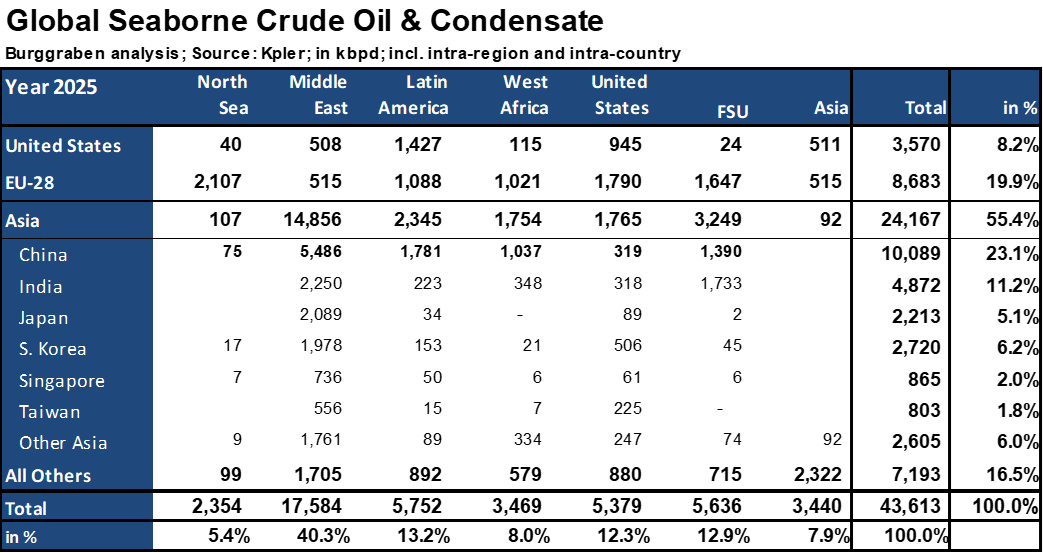
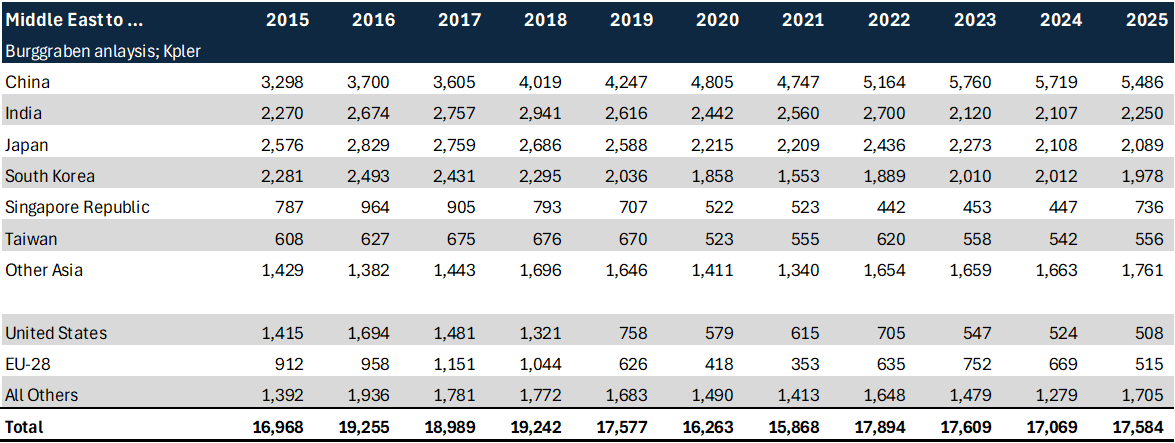
For good order’s sake, and as the above trade flows illustrate: the United States is not crude oil import independent. It imports a total of some 5.9mbpd in June, roughly 4mbpd from Canada via pipeline and the rest via seaborne crude globally, mainly heavy-sour barrels from Latin America (e.g. Venezuela, Guyana, Mexico, Colombia and Argentina) and a few barrels from the Middle East (e.g. Saudi or Iraq).
At the same time, it exports about 4mbpd light-sweet crude from Texas to the world, mainly to Europe and Asia. Those have recently increased to 5.7mbpd, but that was mainly SPR releases that U.S. refiners couldn’t process.