The Sudden End of The MoU
On 29 June, I explained on X (link) that the Memorandum of Understanding (MoU) was really an exercise in constructive ambiguity — the Kissinger playbook of deliberately vague language so that both sides can claim victory. I called it a Memorandum of Misunderstandings. Why?
On the one hand, the MoU assigns responsibility for reopening the Strait to Iran. It states that “the Islamic Republic of Iran will make arrangements using its best efforts for the safe passage of commercial vessels” and that Iran, in consultation with regional states, will determine the future administration and maritime services of the Strait. Tehran wanted that language because it provides a commercial escape hatch from sanctions while preserving its claim to control the Strait.
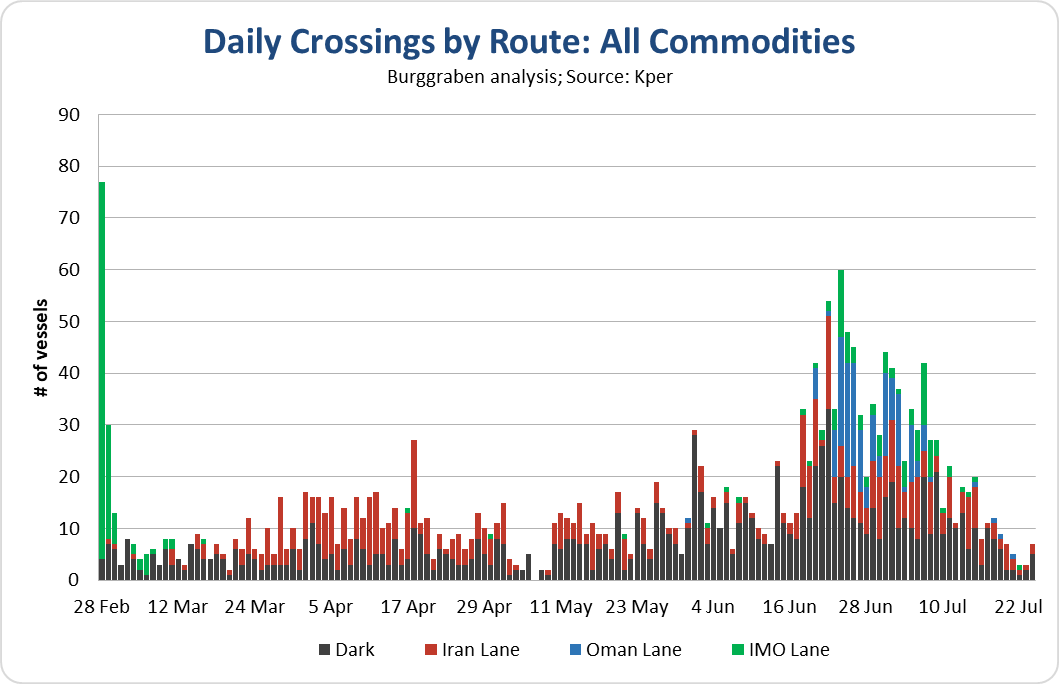
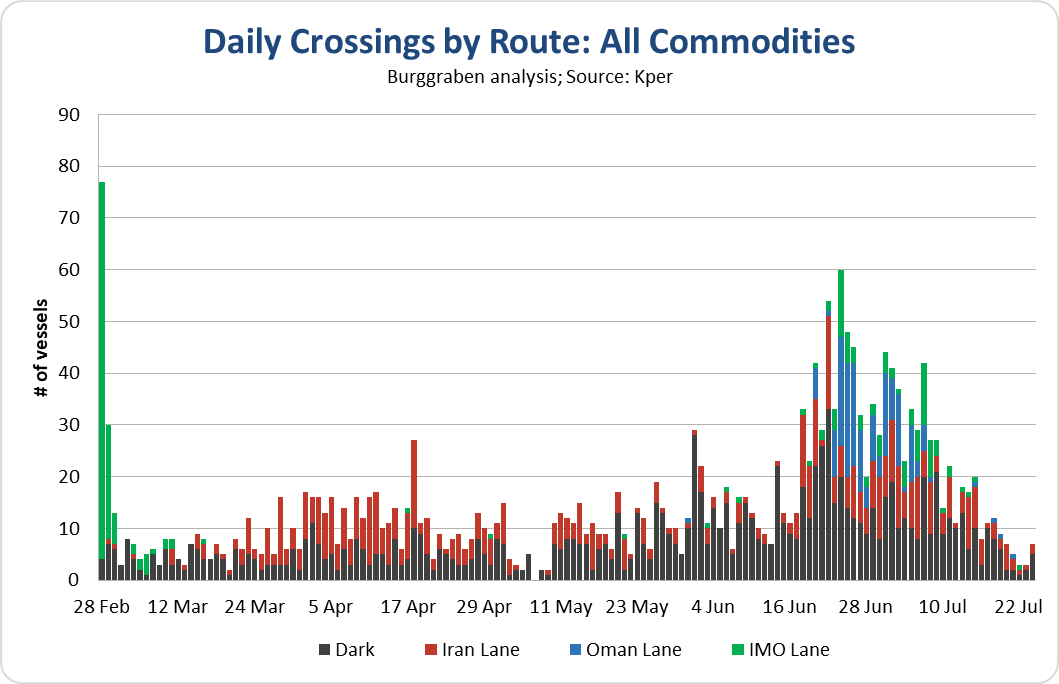
On the other hand, the MoU also says that military obstacles must be cleared and commercial traffic should resume immediately. In practice that meant merchant vessels should be able to use the Omani shipping lane to escape the Persian trap at once. That is precisely what happened — for nineteen days.
Further below I will show you the day the corridor opened, how hard it was used, and the day it closed. But I am getting ahead of myself.
The consequence of the ambiguous language is that Iran’s regime lost its de facto control over the Strait, which it clearly realised. That is why, the same week, it attacked a commercial vessel in the Omani lane: to reassert control. In doing so it breached the MoU, prompting the United States to retaliate.
As I have said many times on X, neither side really gives a fig about the MoU. Iran’s regime wants time — time to refinance itself and to preserve leverage through control of the Strait. Trump wants lower oil prices going into the midterms. Once that political objective has been achieved, the odds of the shooting starting again are, in my view, materially higher. Well, it turns out we did not have to wait long. We are back in fighting mode.
The ‘Irrepressible’ U.S.-Iran Conflict
I was always convinced that there is no solution to this conflict other than (a) regime change, which requires political will on the side of the United States government, or (b) muddling through from an oil market perspective until the Strait of Hormuz is no longer the choke point it is today, because a new network of pipelines will have replaced seaborne exports through the Strait.
Neither is currently the plan of action on any side involved, which is why I expect the disruption to the flow of oil and other commodities to have significant duration.
After nearly six months of conflict with Iran in one form or another, the Trump administration still appears to underestimate the nature of the regime it is confronting.
U.S. policy should begin with a basic working assumption: Iran is unlikely to capitulate simply because military pressure increases. The key question is what Washington expects to achieve. Does it believe Tehran will abandon its missile programme, give up its right to enrich uranium, or relinquish what it sees as its strategic position in the Strait of Hormuz?
There is little evidence that the regime is prepared to make concessions on issues it considers fundamental to the Islamic Revolution. On the contrary, Tehran appears convinced that, over time, Washington’s political resolve will weaken first.
If that is the underlying assumption behind the current strategy, disappointment is almost inevitable. Iran is not going to plead for an agreement or surrender its core strategic assets. The likely consequences are continued upward pressure on oil prices and growing frustration in Washington as expectations collide with reality.
Retaliation is not a strategy, and a bombing campaign without a clearly defined political objective is unlikely to produce the desired outcome. If the goal is to force Iran back to the negotiating table in a significantly weaker position, that objective looks increasingly unrealistic.
Policymakers should be clear-eyed about the costs. A strategy centred on coercing Iran into submission risks imposing substantial economic and strategic costs on the United States and its allies without achieving its intended political objectives.
Iran is far from invulnerable. It has significant military, economic and social vulnerabilities that can be exploited. But one reality remains unavoidable: confronting Iran requires time, sustained political commitment, a willingness to absorb casualties, major economic costs and enormous military resources.
As long as the administration is unwilling to bear those costs, extending the current campaign — even if it produces tactical successes — is unlikely to bring Iran to the point of strategic defeat. If anything, a prolonged campaign without the resources or political will to achieve decisive results risks strengthening Tehran’s belief that it can simply outlast Washington.
The great Walter Russell Mead, perhaps the sharpest writer in a very good WSJ line-up, said it best in a recent article when he called this war “irrepressible”. He wrote:
The core problem is that the conflict between the United States of America and the Islamic Republic of Iran is of the kind that Adams’s boss, Secretary of State William Seward, once famously characterized as “irrepressible.” Iran wants to control the energy resources of the Persian Gulf, and there is no local coalition of states powerful enough to block it without American support. The U.S. has believed for 80 years that ensuring the free passage of Middle Eastern oil and gas to world markets is essential to America’s prosperity and security.
Mr. Trump, a man for whom energy dominance is a central foreign-policy theme, is unwilling to give Iran control of the Strait of Hormuz. Iran may make temporary concessions under grave duress, but it will not, perhaps cannot, abandon the drive for control. Both sides seem to see more reasons to keep fighting than to throw in the towel.
I fully agree, and I expect this conflict to last far longer than markets are currently willing to price.
What Can We Learn from the Crossings of the Strait of Hormuz?
We have assessed every vessel crossing of the Strait of Hormuz reported by Kpler since the war began. We now have a sample large enough to report patterns rather than anecdotes.
Kpler gives us the vessel IMO number, the cargo, the loading port and destination, and the route taken. All of it matters for pattern recognition. We join on IMO number and never on vessel name, because names change and a rename would corrupt the attribution.
Yes, Kpler is an AIS tracking service. AIS stands for Automatic Identification System. It is an automatic tracking system used on ships and by vessel traffic services to prevent collisions and to monitor maritime traffic in real time. It also carries important information on the vessel itself, its cargo and its shipping route — which is exactly what makes it valuable for pattern recognition, and exactly why a ship that does not wish to be seen turns it off.
If a ship switches its AIS off, Kpler cannot see it in real time; only a handful of state players can do that. But Kpler updates daily and backfills history as it becomes clear that a vessel crossed dark to avoid detection by the Islamic Revolutionary Guard Corps (IRGC), the military unit that tries to control the Strait and attacks ships. So the dark crossings are in the data — we simply learn about them late.
One honest caveat before we start. Kpler tells us who owns and who commercially operates each hull, but it does not tell us who insures it. Every statement below about ownership is auditable; nothing below is a claim about insurance cover.
Let us look at the data together.
Total Vessel Crossings
Kpler reported 2,143 crossings — dark or with AIS on — for all commodities, meaning crude oil and petroleum products (together, liquids), LPG, LNG and dry cargo such as fertiliser, between 28 February and 24 July 2026.
That is 147 days, so 14.6 crossings per day across all commodities. On 28 February 2026 alone there were 77. Before the war broke out there were well over 80. In other words, the Strait has been running at roughly 19% of its pre-war rate for five months.
Between 19 and 24 July, as both sides intensified their attacks, Kpler identified 34 crossings in total. That is 5.7 per day, or 7% of the pre-war rate.
Even the most risk-friendly commercial shipping managers do not like it when rockets and drones fly over their heads. So the first learning from this excercise is straightforward and hardly surprising: when the war is hot, expect only symbolic crossings — not commodity trading.