Crude Quality Matters
There is no such thing as “oil”.
Instead, the world produces hundreds of different crude grades, almost as many as there are oil fields, although some fields yield very similar qualities.
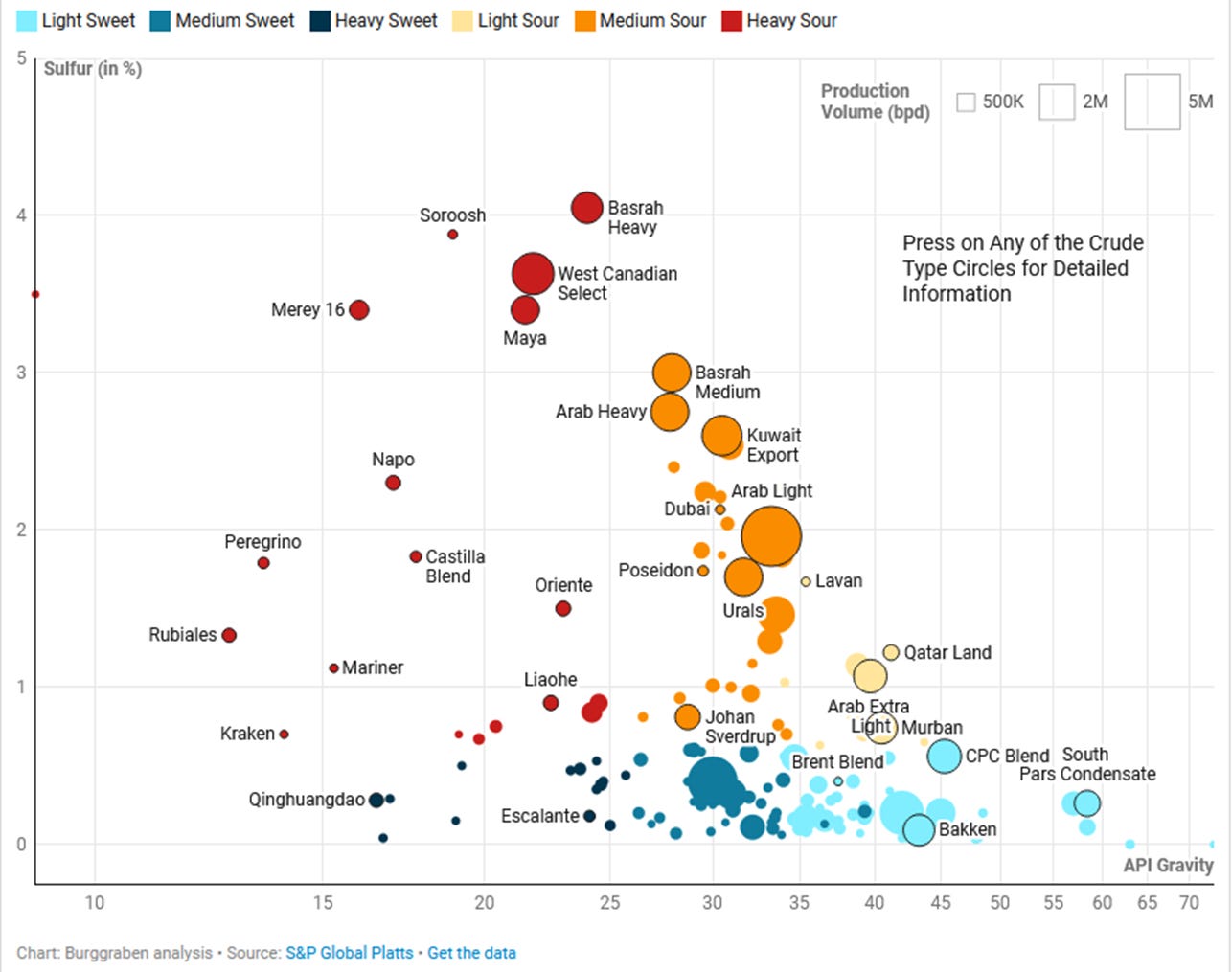
The chart above illustrates this. Think of it as a periodic table of crude. The one below is interactive and works well on a desktop (not so much on a mobile phone), so take a moment to hover over or tap the individual bubbles. Each represents a crude grade, positioned by API gravity on the x-axis and sulphur content on the y-axis. The size of the bubble reflects production volume.
What matters is not just how much oil exists, but what kind of oil it is.
The chart shows 152 crude grades. In reality, there are closer to 700 grades produced across roughly 6,400 extraction areas and more than 2 million active wells. These 152 alone account for roughly 56mbpd of the 85mbpd produced globally each day and are sufficient to make the point.
To begin, focus on the Medium-Sour quadrant, highlighted in orange. You will quickly notice that most of these barrels originate from the Middle East. This is not a coincidence. It is the backbone of the global refining system.
Take Arab Light as an example. It sits squarely in that cluster, with around 1.96% sulphur and an API gravity of 33.3. Production is roughly 4.6mbpd. It is one of the most important barrels in the world.
P.S. Please use the interactive chart on a desktop. It does not scale well on mobile.
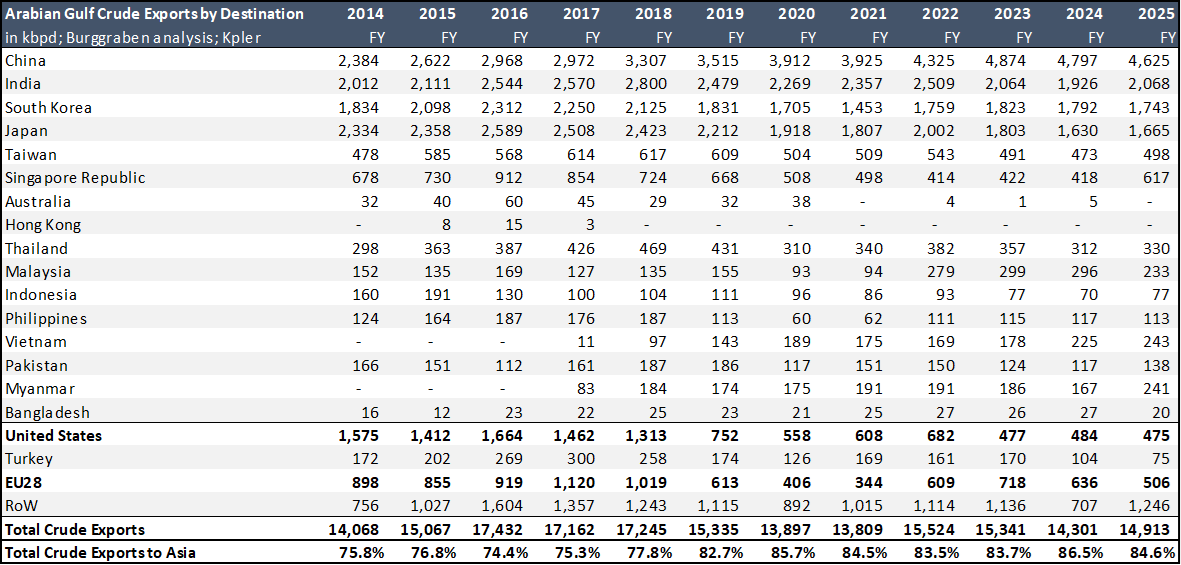
So what does this mean? Roughly 75–85% of Middle Eastern crude exports are shipped to Asia in any given year, as shown in the table below. Refinery systems across Asia have been optimised over decades to run on that specific crude diet.
Refineries are not flexible machines. They can be adjusted at the margin, but they cannot be reconfigured quickly to process entirely different crude qualities while maintaining the same product yields.
And this is the key point the chart above illustrates in simple terms. The missing barrels are not just volumes. They are specific grades, predominantly medium-sour crude, produced at scale in the Middle East.
Those barrels cannot be replaced in the quantities required. Not by the United States, not by Latin America, not by anyone.