Guidance & Thoughts Upfront
Over the coming episodes, I will try to explain, to the best of my ability, different aspects of this Hormuz crisis, share a significant amount of data, most of it hard to obtain and rather expensive, and assess the implications for the global economy. The aim is to stay grounded in probabilities and avoid bias, as markets do not care about our narratives.
As this will take time and there is a lot to cover, each episode will include updated oil balances, as introduced in the Executive Summary. This should allow you to observe the dynamics in real time and act accordingly.
I begin with the Strait of Hormuz itself. For global oil and gas balances, normalising transits through the Strait has no alternative. Without it, a recession arrives in 2026, not 2027. That is unavoidable, as outlined in the Executive Summary. Avoid commentators who describe the situation as “manageable” or “replaceable”.
It is not, at least not in the medium term. U.S. exports cannot solve the problem. They may increase slightly, for instance as SPR barrels are sold due to domestic crude quality mismatches. But fundamentally, U.S. exports do not create new supply. They merely redistribute existing barrels.
Likewise, U.S. shale, often described as a fast-cycle response to price, will remain marginal. The constraint is not time, but geology. The remaining Tier 1 inventory is limited, and the industry no longer has the locations to scale meaningfully where it matters. Think 1-2mbpd. That is highly unlikely. But at least higher prices will further delay the decay of U.S. output. At least I suspect so.
Nor can domestic re-routing solve the problem in the Middle East itself. Beyond the East-West pipeline in Saudi Arabia and limited flows via Fujairah in the UAE, alternatives are constrained, vulnerable and take years to be in place. That is not a near-term response.
And yet, unless the Strait is reopened quickly, closing it will prove a long-term strategic mistake for the regime, should it survive. Why? Because shutting it for more than a few weeks inevitably triggers behavioural change. The pain inflicted by this economic weapon of mass destruction is simply too severe.
That, in turn, accelerates long-term workarounds that marginalise Iran’s influence. New pipeline infrastructure will be developed, and upstream investment will be redirected, at scale.
The 1970s oil crisis offers a clear precedent. It triggered the development of the North Sea basin in the U.K. and Norway, where major discoveries in 1969–1970 led to production ramping from the mid-1970s onwards, ultimately adding millions of barrels per day to global supply.
Venezuela could become part of that adjustment. In 2026, it exports roughly 0.9–1.1mbpd, far below historical levels, and meaningful expansion requires years of investment and infrastructure repair. The world needs to replace up to 14mbpd. This is not the solution, but it is a start.
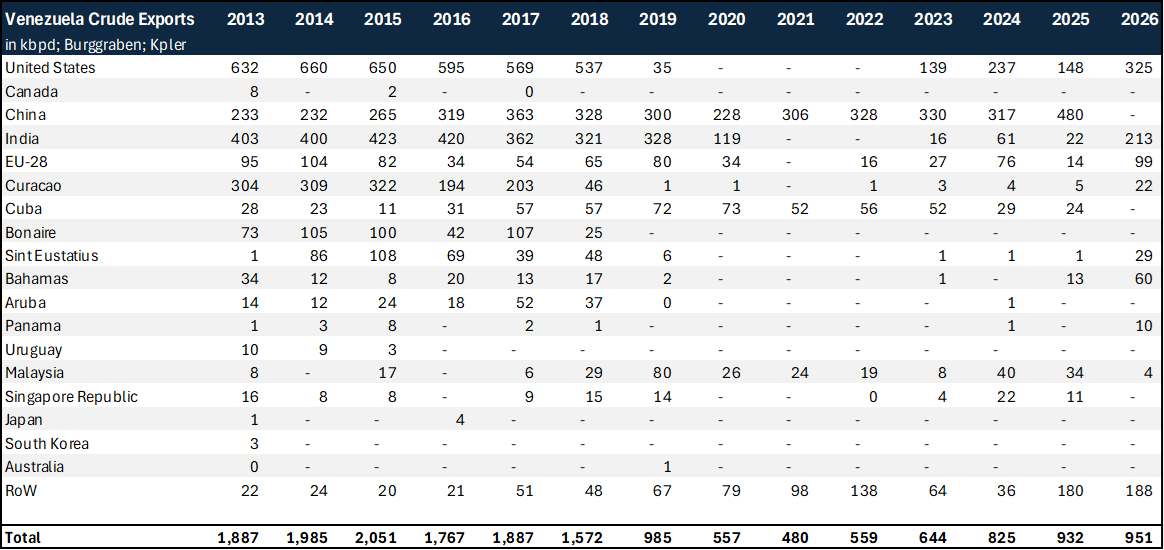
Venezuela’s relevance lies in crude quality. Its reserves are dominated by heavy and extra-heavy sour crude from the Orinoco Belt, the type of barrel currently missing from the Middle East, although extracting and upgrading it remains capital-intensive and time-consuming .
This Venezuela does not possess “spare capacity” in the IEA sense (higher production in 30 days for 90 days), but it is one of the few scalable sources of the right barrel with potential well above the 2mbpd it exported in 2014. Think 5mbpd and beyond.
And yes, of course, the local situation requires years of investment, some with quick yields, others much longer, depending on the field and infrastructure. None of this happens without rule of law. Without it, capital will not return. I discussed this in detail a few weeks ago. So this too requires this administration to finish the job.
Anyway, in the coming episodes, I will cover a range of topics, from crude quality and barrel counting to unintended consequences for Russian exports, the role of LPG in India, the importance of sulphuric acid and other chemicals, and the impact on LNG and even gold. It will be quite a journey.
Today, we begin with what I call the Persian Trap.
Negotiation Failed, Now What?
Almost a full day of negotiations ended with a terse press conference and no deal. Talks between the United States and Iran began on Saturday afternoon and continued through the night, almost 21 hours in total.
The sun had risen in Islamabad by the time Vice President J.D. Vance emerged to brief reporters: “We have not reached an agreement. We’ve made very clear what our red lines are and they have chosen not to accept our terms.” The press conference lasted less than three minutes.
If the Administration believed that, after 21 hours of negotiations, this regime would give up uranium enrichment, as Vance implied, it misread both the moment and the Iranian power structure, in particular the IRGC.
On a lighter note, they did not spend much time studying the past 80 years of conflict and the rather poor track record of reaching lasting agreements, let alone durable peace.
Below is an extract on the Korean War and how it ended, which I published on this Substack. Not many read it. Nor my other pieces on war and peace. Perhaps now is as good a time as any to prepare mentally for what lies ahead?
The Death of Peace Treaties and Why Wars Often End Without Justice
The armistice signed on July 27, 1953, between the United Nations Command and North Korea reaffirmed the 38th parallel as the border between North and South Korea and created the four-kilometer-wide “Demilitarized Zone” (DMZ). The Military Demarcation Line bisects the “Bridge of No Return,” used for prisoner exchanges until 1968, when the crew of the USS Pueblo crossed it into South Korea.
The Korean War lasted just over three years, from June 1950 to July 1953. While fought on a divided peninsula, it was in fact the first hot war of the Cold War—a violent proxy confrontation between the democratic-capitalist West, led by the U.S., and the communist East, led by the Soviet Union. South Korea was supported militarily by U.S. and UN forces; North Korea by China, which sent hundreds of thousands of troops, and by the USSR, which supplied matériel, strategy, and legitimacy.
Because the war was a proxy clash between two worldviews, there was never a foundation for trust, let alone a peace process. Yet negotiations began relatively early, just over a year into the conflict. Formal talks opened in Kaesong in July 1951 and later moved to Panmunjom. Despite stalemate on the battlefield, they dragged on for more than two years, paralysed by disputes over prisoners of war and the demarcation line.
It took more than 700 meetings and nearly two years to negotiate the agreement—almost as long as the war itself. The signing of the armistice took just 12 minutes, conducted in silence at two separate tables so the delegations did not face one another.
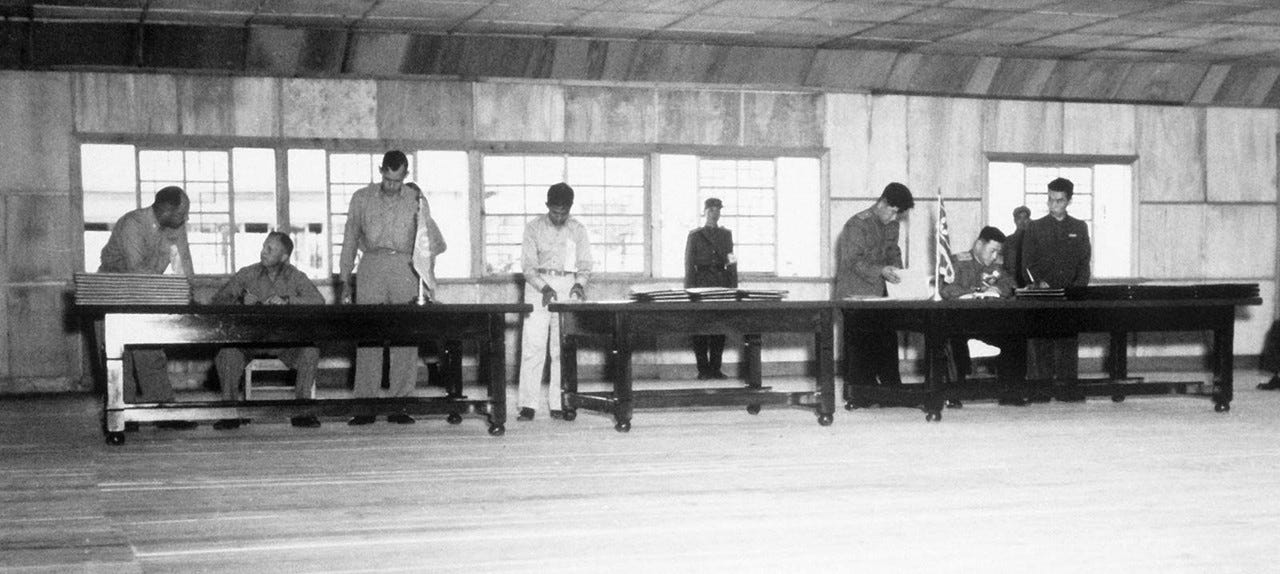
The armistice contained operational provisions, notably prisoner exchanges: Operation Little Switch and Operation Big Switch staged the return of sick, wounded, and eventually all remaining POWs. But beyond this, the agreement was strikingly shallow. After 700 days of talks, the sides had failed to address any core political questions: no peace treaty, no normalisation, no territorial settlement.
Many North Korean and Chinese prisoners refused repatriation, fearing persecution or worse at home. Their resistance became a major stumbling block and symbolised the deeper ideological divide. We see similar dynamics today in Ukraine, where defections and shifting loyalties complicate any prospect of peace.
The Korean settlement was a minimalist framework—closer to a UN resolution than a true bilateral accord. It reflected the smallest possible denominator: not a shared vision, but mutual exhaustion. Violence stopped, but the war never truly ended. To this day, there has been no Korean equivalent of the Tokyo Trials—no reckoning, no justice, no closure for victims. Remember this when you hear calls for a “just peace” in Ukraine.
Since 1953, the armistice has been violated more than 100,000 times. Even during global détente—such as the 1975 Helsinki Conference—tensions on the peninsula deepened. The frozen conflict became a “continuous nightmare”: artillery duels, assassinations, espionage, hijackings, and later, nuclear and missile tests. What was achieved in 1953 was not peace, but stalemate.
And that is why the Korean Armistice matters today: it offers a cautionary lesson to avoid false expectations as the world debates a “just peace” in Ukraine.
From the Iranian side, officials indicated that progress had been made on several points. Two or three outstanding issues, including the handling of the Strait of Hormuz, prevented a breakthrough, according to Foreign Ministry spokesperson Esmail Baqaei. After 40 days of war, mistrust remains deeply entrenched. “Naturally, no one could expect us to reach an agreement after a single meeting. We will continue working to bring Iranian and American positions closer together.”
Baqaei added that the talks took place amid “mistrust and suspicion”, while state media blamed American “excessive demands” for the lack of progress. Both delegations have now returned home without setting a date for further negotiations.
The talks ended in Islamabad on Sunday morning. The path forward remains unclear. Pakistan’s Foreign Minister, Ishaq Dar, urged both sides to adhere to the ceasefire. Iranian officials signalled no urgency to resume discussions. Until the United States presents what Tehran considers a “reasonable agreement”, there will be no change regarding the Strait of Hormuz.
A breakthrough was always unlikely
Reaching an agreement on such a complex and multi-layered dossier over a single weekend was never realistic. The more relevant question was whether a framework for continued negotiations could be established. That would have required both sides to recognise the altered realities after six weeks of war and move away from maximalist positions.
For Iran, this centres on uranium enrichment, a red line for Trump. During the last round of talks in Geneva, Iran was reportedly prepared to make meaningful concessions. Its enrichment facilities in Fordo, Natanz and Isfahan are believed to have suffered significant damage, although it remains unclear how quickly operations could be restored.
The last nuclear agreement between the United States and Iran took two years to negotiate. The more likely outcome now is an interim arrangement that addresses part of the dispute and buys time. Iran would need to relinquish control over the Strait of Hormuz and potentially limit its near-weapons-grade uranium. The United States would need to offer economic relief, for instance by unfreezing Iranian oil revenues held abroad under sanctions.
For context, the last serious attempt at a nuclear agreement, the JCPOA, was led by President Obama and finalised in Vienna on 14 July 2015 between Iran and the P5+1 (China, France, Russia, the U.K., the U.S., plus Germany) together with the European Union. Formal negotiations began in November 2013 and took roughly 20 months to reach a framework.
In essence, Iran agreed to limit enrichment, reduce centrifuge capacity and accept intrusive IAEA inspections in exchange for sanctions relief. The deal took effect on 20 January 2016.
Even then, it remained politically fragile. President Trump withdrew from the agreement in 2018, effectively collapsing the framework.
The dilemma is as much about sequencing as substance. Iran views uranium as leverage, to be traded for a comprehensive agreement, not a temporary one. The United States prefers to resolve the issue early, rather than allow it to remain in Iranian hands during a prolonged negotiation.
Each side expects the other to concede. The Iranians believe they hold the upper hand, having endured six weeks of bombing by far stronger opponents while inflicting significant damage on the global economy. Time, in their view, is an ally. To them, Trump appears increasingly eager to end the war before elevated energy prices weigh on the Republican Party ahead of the midterm elections.
The United States sees it differently. While the war has fallen short of several objectives, it has weakened Iran’s leadership, its armed forces and its economy. A further escalation would likely be more painful, particularly if the United States and Israel intensify attacks on infrastructure and economic targets.
My own view is that the U.S. focus on the nuclear file risks granting Iran excessive leverage. Based on my research, the regime lacks both the financial and industrial capacity, as well as the political time, to rebuild its nuclear programme meaningfully before internal pressures mount. This raises the question whether the nuclear issue is primarily a negotiating tactic: insist on it now, only to accept a more ambiguous compromise later in exchange for reopening the Strait.
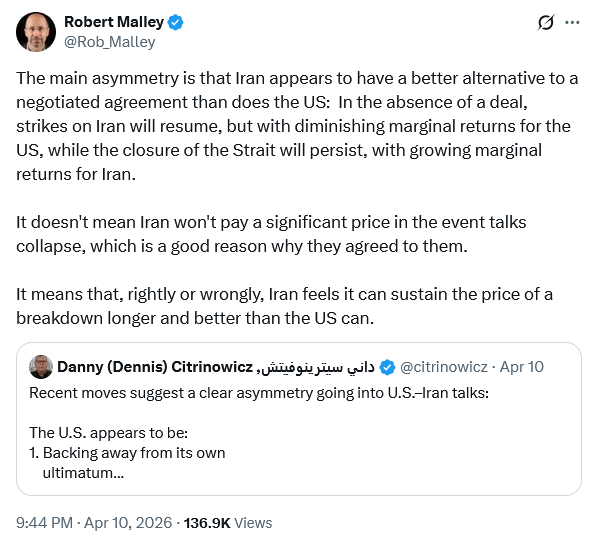
Meanwhile, Iran expert Robert Malley highlighted what we outlined in the Executive Summary: time favours Iran, at least in its own perception. The closure of the Strait generates increasing marginal returns for Tehran, while additional strikes deliver diminishing marginal returns for the United States.
The Persian Trap
Another sticking point is the Strait of Hormuz, and what I call the Persian Trap, the Persian Gulf is easy to enter, but not necessarily to leave.
Iran has pledged to keep the waterway open during the ceasefire. In practice, only a handful of ships have been able to transit the Strait. According to U.S. officials, one reason is that Iran itself may no longer be able to locate all the mines it has deployed.
Iranian officials have indirectly acknowledged these constraints. Foreign Minister Abbas Araqchi noted that any reopening would take place “taking into account technical constraints”. That may reflect genuine operational limits, or simply a mechanism to control flows and extract rents.
Following the U.S. and Israeli strikes on 28 February, Iran asserted de facto control over the Strait. As part of the ceasefire, it signalled to mediators that crossings would be limited to roughly a dozen vessels per day, subject to tolls. President Trump, by contrast, has insisted on a full reopening.
In reality, shipowners from Greece, China, India and Pakistan are now negotiating individual crossings with the Islamic Revolutionary Guard Corps. Toll payments reportedly reach up to US$2m for VLCCs. Iranian vessels are exempt.
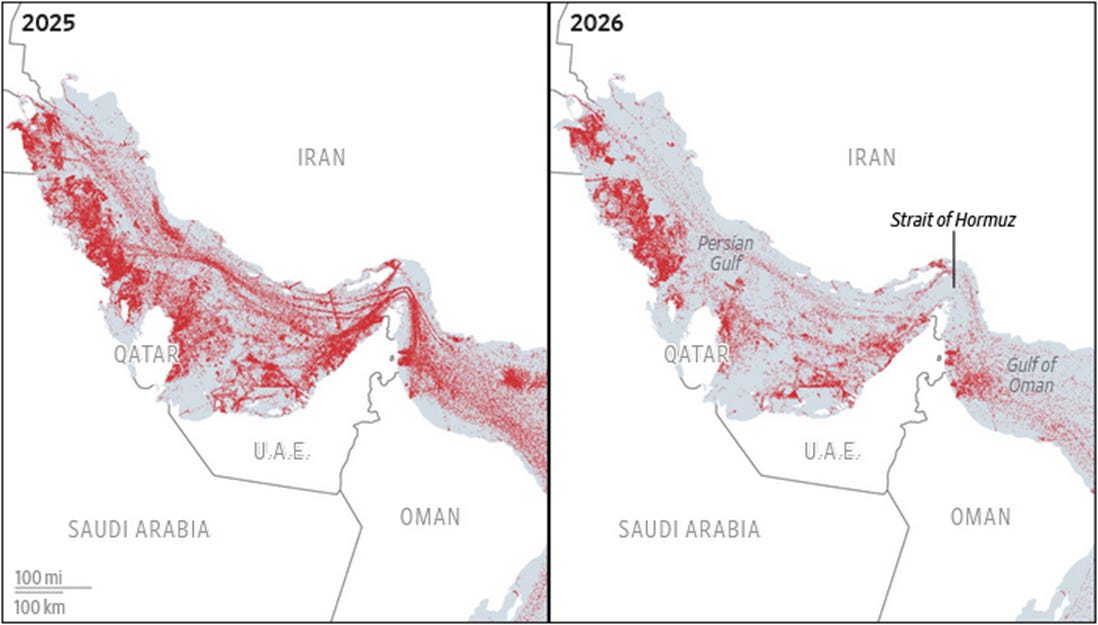
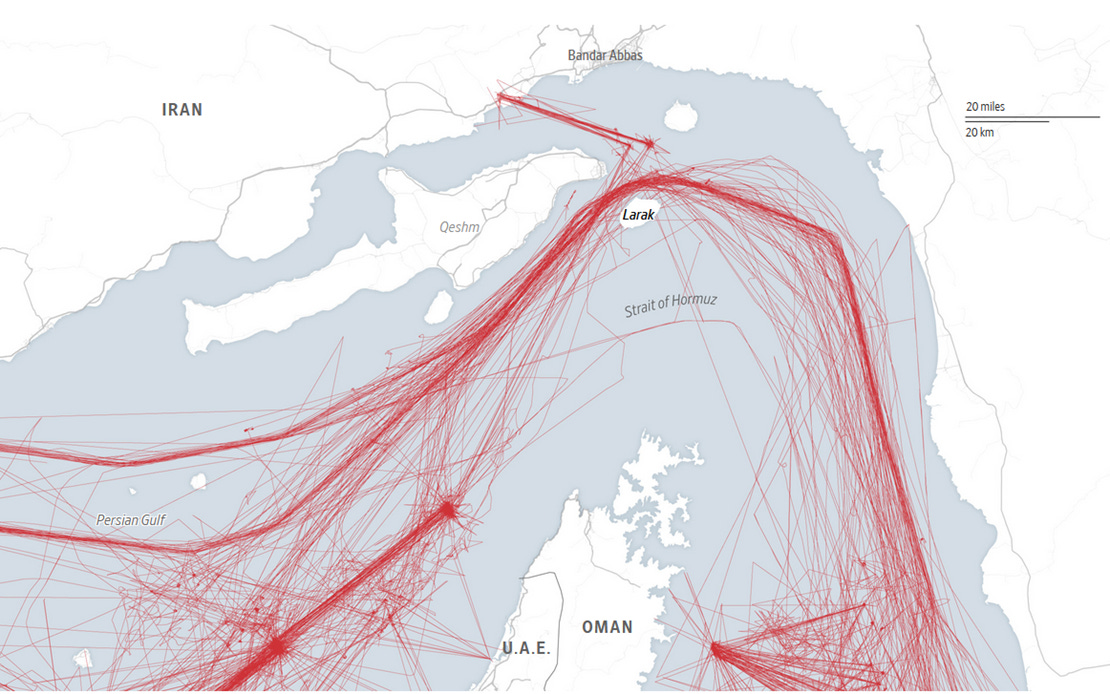
What we can observe is the routing. Approved vessels are directed north of the standard shipping lane, navigating a narrow corridor between Qeshm and Larak, hugging the Iranian coastline before exiting into the Gulf of Oman.
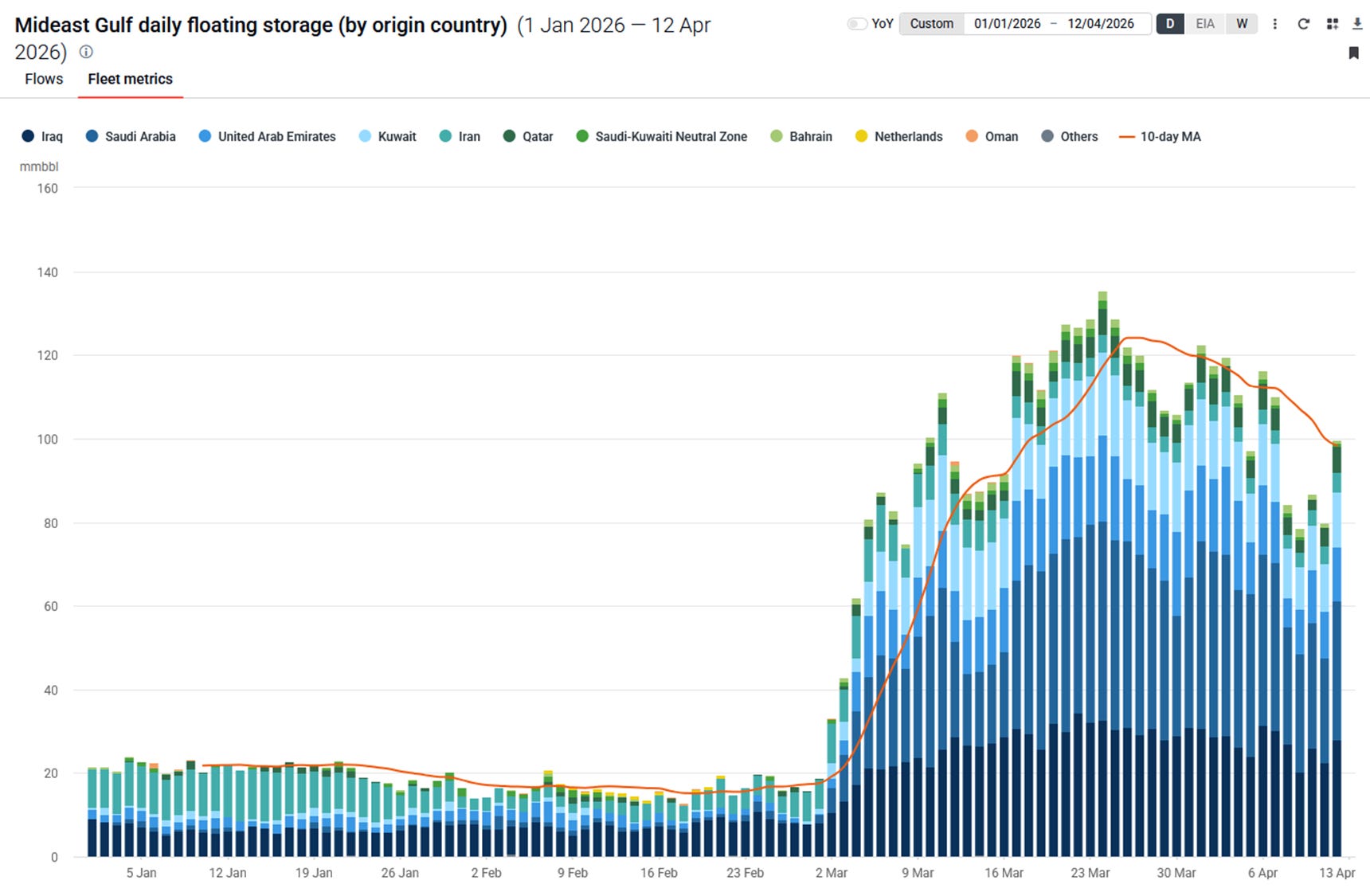
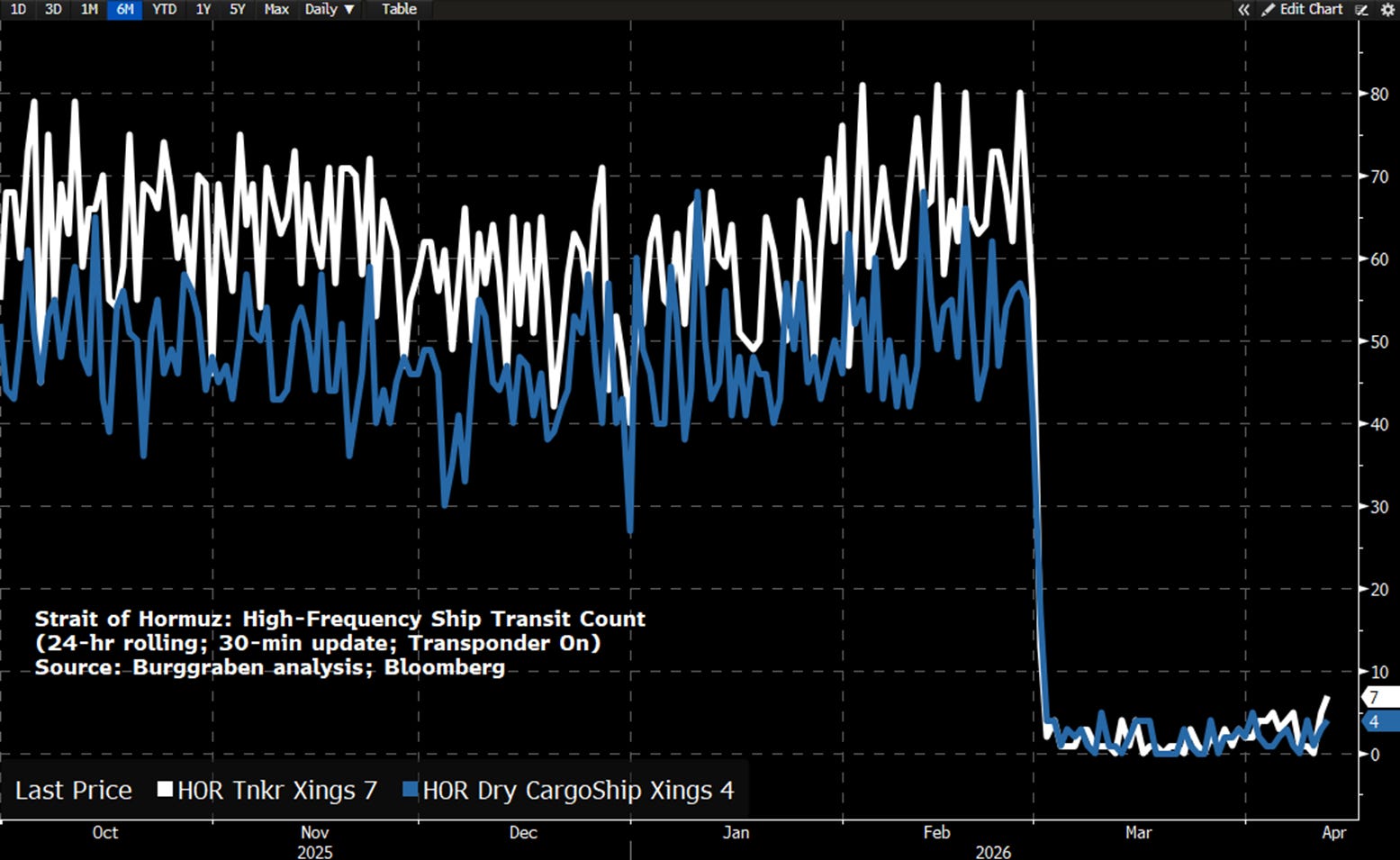
Pre-war, roughly 130 vessels transited the Strait daily. Since the conflict, flows have collapsed. Between 13 March and 9 April, only 122 crossings were recorded in total, across all cargo types. In other words, one month of traffic now equals a single pre-war day.
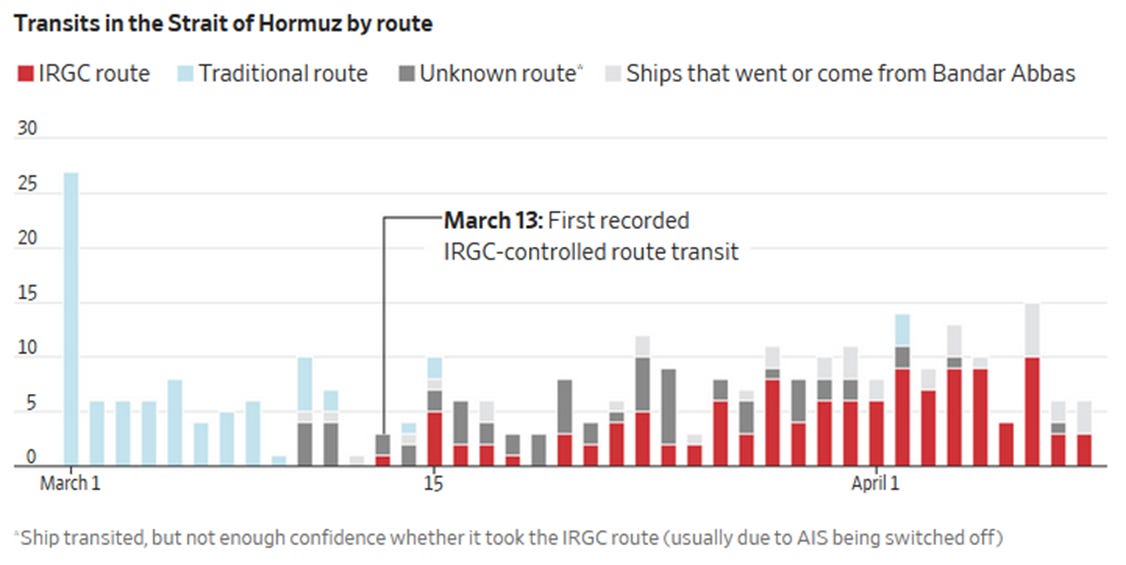
The majority of these movements are bulk carriers and tankers carrying petroleum products, primarily linked to Iranian exports into markets such as China and India.
Technically, the northern route is viable, but only just. The Strait’s depth ranges from 30–90 metres, while the northern corridor offers roughly 25–30 metres. That is sufficient for some fully laden VLCCs with drafts approaching 20–30 metres, but it leaves little margin for error. The route works, but it does not scale.
And scaling is the issue. The northern route cannot replicate the throughput of the standard channel. Even under a ceasefire, expect a structural bottleneck across all vessel classes. Crude tankers will not receive priority.
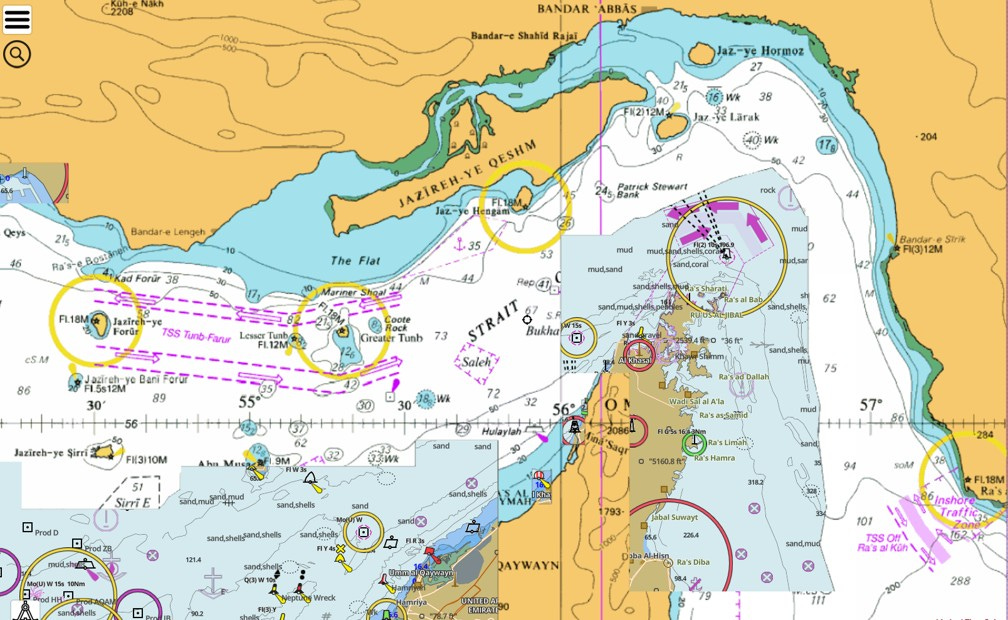
From a purely technical standpoint, I would expect 5–10 vessels per day to exit the Strait during a ceasefire, assuming it holds. The constraint is not only physical, but operational. For vessel operators, this is an execution nightmare.
The backlog already sits at 800–900 vessels. At 10 per day, clearing it would take 80–90 days, assuming no further disruptions. That is a heroic assumption. Entries are effectively zero, excluding Iran’s dark fleet. Without inbound flow, the system cannot normalise.
The core point is simple: until the trapped fleet exits safely, no rational operator will accept entry risk. You cannot price this level of schedule uncertainty. The opportunity cost alone is prohibitive.
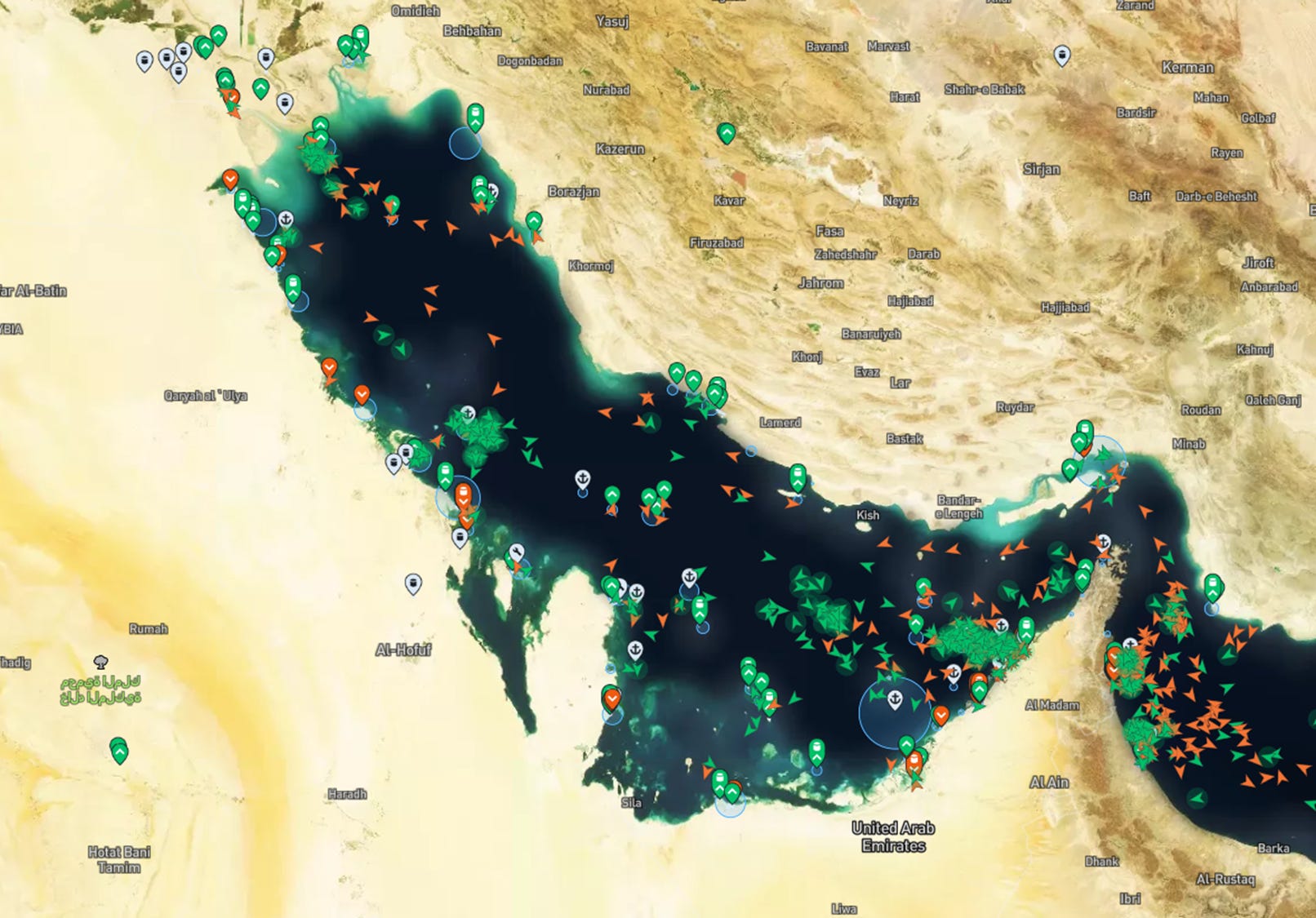
The implication is that this crisis extends well into July and likely beyond, potentially bleeding into 2027, regardless of any temporary SPR releases. Tehran will not relinquish the Hormuz lever easily. It is an economic deterrent, cheaper and, in this context, more effective than a conventional weapon.
Example from a Financial Times article:
Jakob Larsen, chief safety and security officer at Bimco, advised members to “await further guidance from the relevant authorities”, warning that transit currently involves “heightened risk”.
The toll regime introduces an additional constraint. Payments may violate U.S. sanctions. As Lars Jensen of Vespucci Maritime noted, shipowners face a binary choice: keep vessels stranded in the Gulf or pay Iran and risk breaching sanctions.
Shipbrokers said insurance also remained a big challenge. “The situation remains clear as mud . . . the main stumbling block for most parties remains a lack of clarity around insurance,” one told the FT.
Anchan, the chief executive of Safesea, said underwriters were requiring shipping companies to provide proof of approval from the IRGC before providing insurance but “no one has a clue where to get this approval from”.
David Smith, head of marine at insurance broker McGill and Partners, said there had been “a huge volume of requests for quotes since the ceasefire”. But he noted that the strait was still “classified as a very high-risk area” by the insurance market’s Joint War Committee, whose designations influence the premiums set by underwriters.
Cargo insurance rates quoted for shipping through the strait have fallen from about 7.5 per cent of the insured value of goods last week to roughly 3.75 per cent on Wednesday, according to one large broker.
Signal Versus Noise
I still expect more vessel transits to be registered in the coming days, perhaps weeks, even in the absence of a deal. That, however, is not what matters. After all, exits from the Strait resemble the kind of escape one would expect after being trapped for six weeks.
For the purpose of re-establishing the regular supplies of oil flows, what exits the Persian Trap during this ceasefire is largely irrelevant for long-term oil and gas balances, or for products such as LPG and fertiliser. It is, in effect, one-off noise.
Yes, if the above calculations hold, and assuming the ceasefire is extended, roughly 80 million barrels of trapped crude and products could reach their intended destinations. But that remains a one-time release.